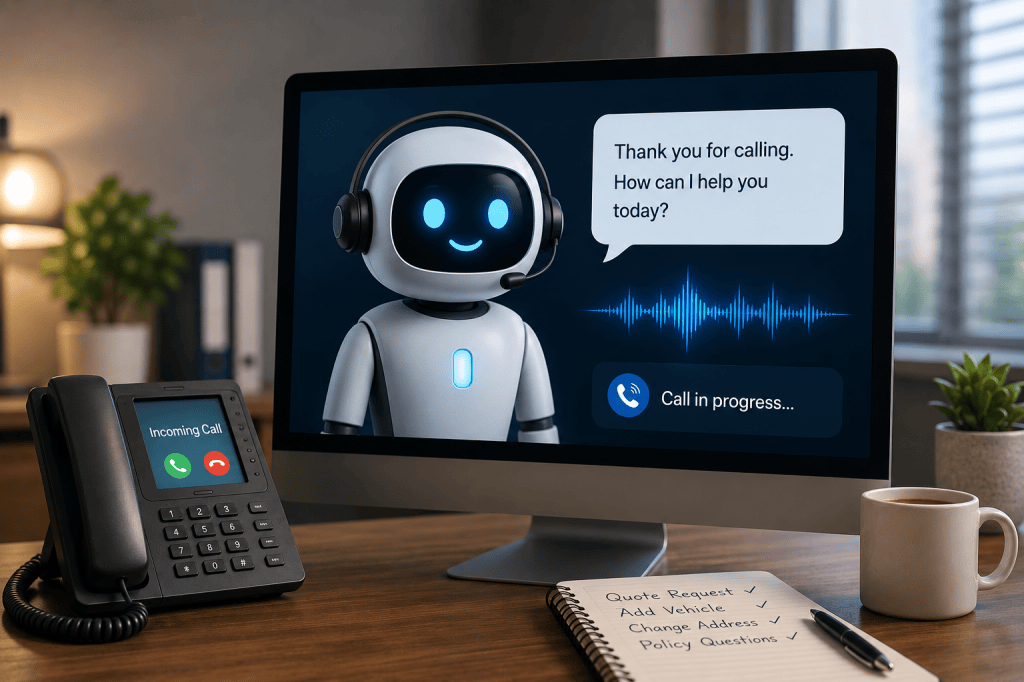
For Gerald Hemphill, owner of GFH Insurance Agency, adopting voice AI wasn’t about chasing the latest technology trend. It was about solving a business problem. His agency was receiving nearly 200 calls a day. “There were 12 people in the office and the phone seemed to be ringing off the hook. It was frustrating. It was noisy. My staff was burned out,” Hemphill explains.
Like many agency owners, he found himself caught between growing service demands and limited resources. Hiring another employee simply to answer phones didn’t seem like the right answer. Instead, he began evaluating voice AI solutions.
What ultimately convinced him to move forward wasn’t the technology itself, it was the practical application. The solution integrated directly with the agency management system. Known callers could be identified automatically, and call transcripts were attached directly to customer records.
The transition wasn’t entirely seamless. Some customers were skeptical. A few felt uncomfortable speaking with an AI assistant. In response, GFH adjusted the process. Customers are now informed immediately that they are speaking with AI, and the agency created a VIP list that allows certain clients to bypass the technology and connect directly with staff members.
Most importantly, the agency focused on demonstrating value. One customer called after hours needing information to complete a DMV form. The AI gathered the necessary details and created a transcript. By the time Hemphill returned the call, he already knew exactly what the client needed.
“When I called back, I was able to say, ‘Look how quickly we got the information for you,’” he explains. Another caller needed to add a vehicle. The AI collected the VIN, confirmed whether a trade-in was involved, and gathered the information needed to complete the endorsement before an employee ever became involved.
Hemphill often describes the technology in the simplest possible terms: “I tell people it’s like voicemail—it’s just smarter.”
One surprise was how much value the system delivered right out of the box, according to Taylor Paschal, Account Operations Manager at GFH. “The software company’s default quote request and servicing workflows collected most of the information our agents needed with very little customization,” she says. “That allowed us to focus our efforts on refining tone, call outcomes, and post-call actions rather than building everything from scratch.”
Paschal, who previously worked as a Knowledge Management Consultant outside the insurance industry, says one of the biggest lessons was recognizing that insurance customers are different from many other consumers.
“In other industries, the goal is often to drive as much self-service as possible,” she explains. “But people choose to work with an independent insurance agency because they want access to real people who can help them. The goal isn’t to avoid customer interactions. The goal is to make those interactions better.”
The technology changed how employees spend their time. “Implementing voice AI doesn’t decrease the workload. It changes the cadence and the types of tasks left for the team,” she says. “Instead of answering every phone call or spending time gathering basic information, our team can focus on customizing coverage, servicing accounts in real time, and identifying account-rounding opportunities.”
Nearly a year after implementation, Paschal still reviews interactions daily and works with the vendor to improve the system. “Any time saved through productivity gains needs to be poured back into continuous improvement,” she says. “The most successful implementations are the ones that solve real operational problems and then continue to evolve.”




Leave a Reply