
For years, the insurance industry has been preparing for the rise of the do-it-yourself customer. The theory seemed straightforward. As technology improved, consumers would increasingly purchase insurance online, service policies through apps, and navigate portals. Self-service would become the dominant model, and agencies would need to adapt or risk becoming irrelevant.
Part of that assumption is that customers want to do more themselves. But most customers aren’t looking for an end-to-end do-it-yourself experience, but an easier one. Across industries, many have embraced digital tools and self-service to a degree. But buyers continue to look for expert guidance when decisions are complex, consequences are significant, or the stakes are personal. Consumers aren’t rejecting human expertise, but they are looking to reduce unnecessary friction in their purchase and service experiences.
For example, people still hire financial advisors despite having access to robo-investing platforms. They still seek professional tax advice despite increasingly sophisticated software. And while consumers have more access to insurance information than ever before, including AI-powered tools capable of answering coverage questions quickly, many continue to seek expert guidance, especially when the stakes are high.
“The DIY client is really about choice,” says Patrick Espeland, vice president of product at Dyad. “Some clients are going to want to take on more of the insurance experience themselves. Others want a trusted advisor readily available when they need one.” They aren’t choosing between technology and human expertise. They increasingly expect both.
The Information Problem
Today’s customers have access to an endless supply of information, from online reviews and educational content to AI tools capable of analyzing policies and answering insurance questions. In fact, many are already turning to generative AI to research insurance products and coverage questions before speaking with an agent.
But more information doesn’t necessarily produce better decisions. Joel Dunham, president of Ovation Insurance, recently tested that theory himself. Curious about AI’s insurance knowledge, he entered licensing ethics questions into ChatGPT. The result: a score of roughly 72 percent. That’s not terrible. But it also isn’t good enough to replace professional judgment.
Aaron Levine, founder and CEO of LG Insurance Agency, sees the same dynamic at play outside of insurance. After trying to troubleshoot problems with his home’s speaker system using YouTube videos, he eventually called in a professional. “I rely on professionals to help me with a lot of different things,” he says. “Insurance customers are often no different. They may begin their journey online, getting information from search engines, social media, or AI tools, but when decisions become complex or the stakes are high, most still want expert guidance.”
The result highlights a growing challenge for agencies. Consumers may arrive at conversations armed with more research and greater confidence. But access to answers isn’t the same as expertise. More agents are encountering customers who have already researched coverage online. Some of that information is useful, some of it is incomplete and some of it is wrong.
“Most of the time, when we see somebody do their own quotes, they’re undervalued, underinsured, and then they get into trouble,” Levine says. The opportunity for agents isn’t to compete with information. It’s to help customers interpret it, apply it to their unique circumstances, and understand the risks that may not be obvious from an online search or AI-generated answer.
The Service Squeeze
Customers aren’t asking agents for a different insurance experience. But they’re bringing expectations shaped by every other digital experience in their lives, including Amazon, Uber, and online banking. They want routine tasks to be simple, fast, and available on demand, while still having access to expert guidance when they need it.
“The biggest thing for us is to make things easier for clients,” says Dunham. “We want to create that Amazon-like experience. The question we’re always asking ourselves is: are we making things simpler for our clients, or are we making them more difficult?”
Answers to questions like these can impact how agencies think about service and the tools used to support the experience. In the past, self-service has largely meant portals, apps and online forms. The customer had to log in, navigate the system and complete the task.
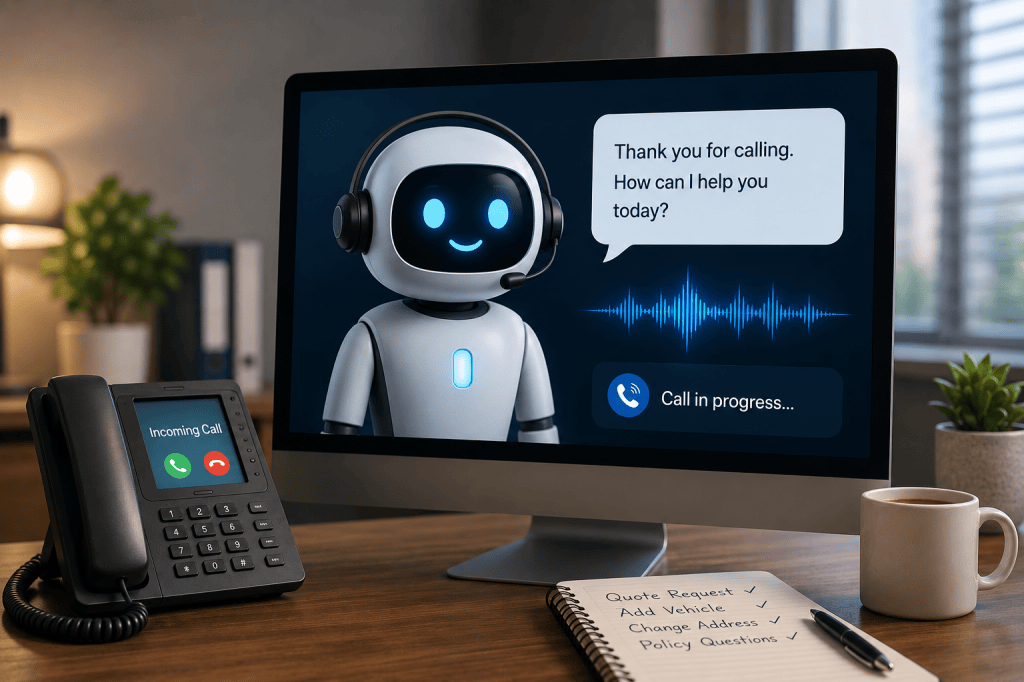
But newer technologies like voice AI are changing the equation. Rather than simply extending office hours, agencies are increasingly using AI to handle routine service interactions, reduce administrative workload, and create more capacity for employees to focus on higher-value client conversations.
A recent study of consumers from Sonant found that more than half said they’re comfortable using AI-powered voice systems for routine insurance questions, and 58 percent said they’re willing to try AI-powered service experiences. At the same time, nearly the same percentage say they want access to a human when issues become more complex.
“As agencies grow, they often find themselves spending more time servicing business than growing it,” says Francisco Lopes, CEO of Sonant. “Many routine customer interactions don’t require a licensed agent, but they still consume valuable staff time. Technology can help agencies handle those conversations more efficiently while preserving human expertise for advice, problem-solving, and relationship-building.”
Customers don’t necessarily want to talk to an agent to make a payment, check claim status, or request a routine document. They do want to talk to an agent when they’re buying coverage, filing a claim, or making a significant financial decision. Historically, providing 24/7 availability required additional staff, after-hours service arrangements, and expense for the agency. Technologies, such as voice AI, may allow agencies to be more responsive while preserving human expertise for the moments that matter most.
The Relationship Paradox
There’s an interesting dynamic at play. Technology may not reduce the value of the independent agent; it may make the value easier to see. “Trust is built when you set expectations clearly,” says Vaibhav Saxena, CEO of Infer. “When agents implement technology, the goal isn’t to replace the agent. It’s to make sure licensed agents spend time on the conversations that matter most.”
One of the most surprising observations from agencies is that technology isn’t necessarily reducing the desire for human interaction. In some cases, it’s increasing it. According to Dunham, while his agency has experimented with various digital tools over the years, he has recently seen more customers gravitating back toward phone conversations and direct communication. Saxena agrees, “We’re seeing that people just love picking up their phones to talk to a human.”
Levine is experiencing a similar dynamic. Despite the growing availability of portals and self-service tools, many clients—particularly those with complex personal or commercial risks—still want direct access to someone they know and trust. “We can use the technology to help us streamline things so we can spend more time connecting,” Levine says.
Expertise, advocacy, and trust are some of the key reasons consumers work with agents. Technology can enhance those strengths making agencies faster, more responsive, and easier to do business with. Most customers don’t enjoy completing forms, uploading documents, or tracking down policy information. They want outcomes, answers, and problems solved quickly. The agencies that thrive over the next decade won’t be the ones that automate the most. They’ll be the ones that automate the right things while doubling down on the expertise and trust that customers can’t get from a portal, chatbot or AI assistant.
The DIY Myth: Six Things We Got Wrong
For years, the insurance industry has been preparing for a future shaped by self-service, automation, and digital-first customers. But some of the assumptions behind the DIY movement haven’t played out the way many expected.
1. Myth: Customers Wanted to Do Everything Themselves.
What they actually want: An easier experience. Most customers are happy to pay a bill online, access documents through a portal, or check claim status after hours. But when coverage decisions become complex or the stakes are high, they still want expert guidance.
2. Myth: More Information Would Create Better Decisions.
What actually happened: More data often creates more confusion. Consumers have access to online reviews, search engines, social media, and now AI-powered tools. But information isn’t expertise. Agents increasingly find themselves helping customers sort through conflicting advice and understand what actually applies to their situation.
3. Myth: Self-Service Would Reduce the Need for Agents.
What actually happened: The areas where agents create value is shifting. Technology is becoming more effective at handling routine transactions. That frees agents to spend more time advising clients, solving problems, and helping customers navigate risk.
4. Myth: Digital Convenience Would Replace Relationships.
What actually happened: It raised expectations. Customers want insurance interactions to be as easy as online banking, Amazon, or Uber.
5. Myth: AI is Replacing Humans.
What actually happened: The most promising applications are helping humans. Whether it’s voice AI, automation, or workflow tools, many agencies are using technology to handle repetitive tasks, improve responsiveness, and give staff more time for client conversations.
6. Myth: The Winners Would Be the Most Automated Agencies.
What actually happened: The most successful agencies remove the most friction from client experiences. Technology alone isn’t a competitive advantage. Agencies that combine speed, convenience, and accessibility with expertise, advocacy, and trust customers can’t get from a portal, chatbot, or AI assistant are leading.


 PIA Connection Online
Leave a comment